Gospel Doctrine · July 5, 2026
"If the Lord Be God, Follow Him"
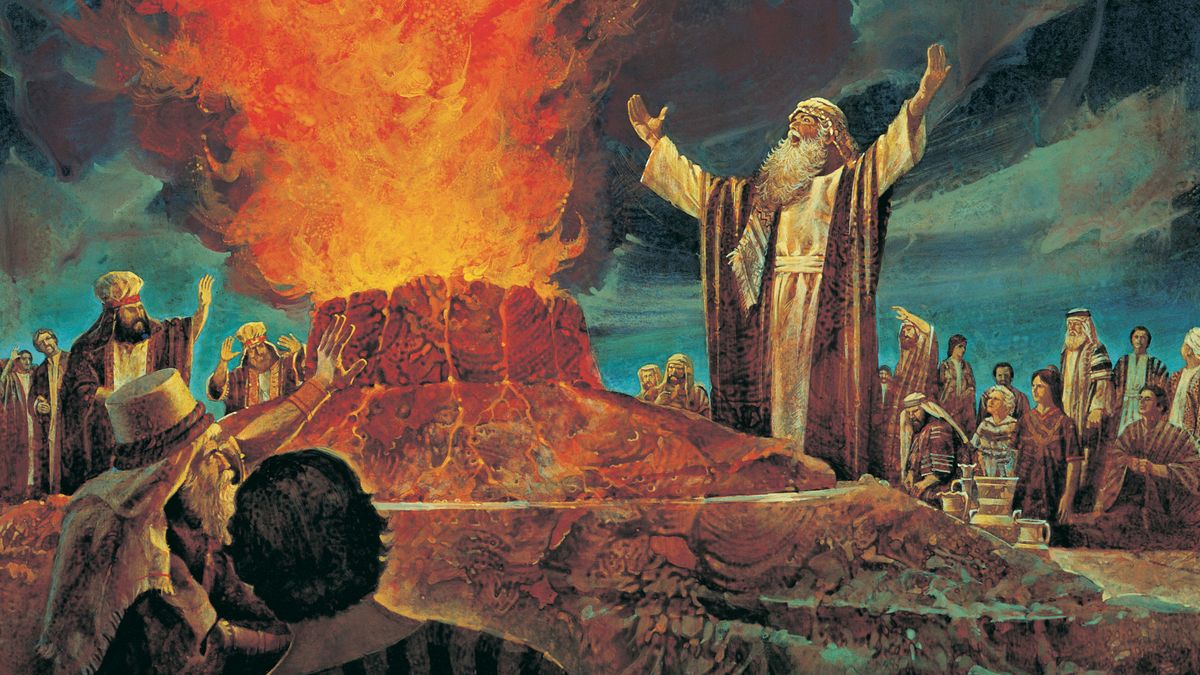
Elijah Contends against the Priests of Baal · Jerry Harston
Last week · June 22–28
2 Samuel 11–12; 1 Kings 3; 6–9; 11
2 Sam 11–12King David takes Bathsheba, wife of Uriah, a soldier in his army, then has Uriah killed. Nathan, the prophet, confronts him: "thou art the man."
1 Kgs 3Solomon, David and Bathsheba's son and new king, asks God for an understanding heart instead of riches.
1 Kgs 6–9Solomon builds and dedicates the temple; the Lord's glory fills the house, with a warning attached.
1 Kgs 11Solomon's foreign wives turn his heart to other gods; the Lord promises the kingdom will be torn from his son.
This week · June 29–July 5
1 Kings 12–13; 17–22
1 Kgs 12–13Rehoboam, Solomon's heir, answers a labor grievance with threats; ten tribes secede and crown Jeroboam, Solomon's former foreman, who builds golden calves so no one goes south to worship.
1 Kgs 14–16(skipped by the manual) Fifty years of coups and purges end with King Ahab and Jezebel, his Sidonian queen, making Baal the state religion.
1 Kgs 17–19Elijah, the Lord's prophet to the north, declares drought, is fed by a widow's last meal, calls fire on Carmel, then despairs, and hears a still small voice.
1 Kgs 20–22Ahab's wars; Jezebel has Naboth, a farmer who refused the king his vineyard, judicially murdered; Micaiah, one lone prophet, faces four hundred court prophets.
Setting · The kingdom splits
Ten tribes vs. two · 1 Kings 11:31–36; 12:20
Who's who from here on
North · ISRAELTen tribes under Jeroboam. Capital later Samaria. No temple; golden calves instead. Coup after coup; every king does evil. Elijah's whole ministry happens here.
South · JUDAHTwo tribes under Rehoboam. Jerusalem and the temple. David's line kept on the throne "for David my servant's sake" (1 Kgs 11:36).
Part 1 · Christlike leaders serve the people they lead
Read vv. 3–4 aloud. What exactly are the people asking their new king for?
What does it feel like to bring a real grievance to someone with power over you?
Part 1 · Christlike leaders serve the people they lead
The old counselors say: be a servant to this people, "and they will be thy servants for ever" (v. 7). The young men say: add to their yoke. Why does the second answer sound better to Rehoboam?
Why do we prefer counsel that flatters us over counsel that costs us?
Part 1 · Christlike leaders serve the people they lead
"My father chastised you with whips, but I will chastise you with scorpions" (v. 14). Ten tribes walk. What did one arrogant answer cost?
What Christlike attributes could have saved his kingdom, and how can you use them as a leader, whether in a Church calling or as a leader of your own life?
Part 2 · A religion of convenience
Before any of this, the prophet Ahijah promised Jeroboam the same deal David got: walk in my ways and "I will build thee a sure house" (v. 38). What was actually on the table for him?
Does God's confidence in us depend on our pedigree, or on what we do with what He hands us?
Part 2 · A religion of convenience
"It is too much for you to go up to Jerusalem" (v. 28). Read v. 26. What is Jeroboam actually protecting?
Where do we accept convenient substitutes for the real thing?
Part 2 · A religion of convenience
Read both aloud. Jeroboam repeats Aaron's golden calf words word for word. Neither claims a new god; each offers an easier way to worship the real one.
What do our more manageable versions of God look like?
Part 2 · A religion of convenience
A counterfeit temple, piece by piece
The place · 12:26–27Bethel, Jacob's "house of God" (Gen 28:19), ten miles north of Jerusalem: every pilgrim's road to the temple passes it first.
The idol · 12:28–29Golden calves standing in for the ark, sold in Aaron's exact words.
The priests · 12:31Levites out; priests "of the lowest of the people, which were not of the sons of Levi."
The feast · 12:32–33The autumn feast copied, moved to a month "devised of his own heart."
The priest king · 12:33Jeroboam offers the incense himself. Every ingredient looks real; the assembly is counterfeit.
Part 2 · A religion of convenience
"Jeroboam convinced himself that some of God's commandments were not applicable to him. … Our partial or selective compliance with God's laws will fail to bring the full blessings of obedience."
Elder Bruce A. Carlson · "When the Lord Commands," Apr 2010
Which commandments are easiest to quietly decide don't apply to us?
Part 2 · A religion of convenience
A man of God cries against the altar at Bethel, and King Jeroboam stretches out his hand: "Lay hold on him" (v. 4). What happens to the hand, and who does the king immediately need?
Have we seen people react just as strongly against the teachings of prophets in our day? What does the reaction itself reveal?
Part 3 · An invitation to sacrifice is an opportunity to exercise faith
Elijah announces the drought and then hides by the brook Cherith, fed by ravens. What does it tell us that even the prophet lives meal to meal through this famine?
When has the Lord sustained you one day at a time instead of all at once?
Part 3 · An invitation to sacrifice is an opportunity to exercise faith
Read v. 12 aloud. The widow is gathering two sticks. What is she preparing to do, in her own words?
What would you have said in her place?
Part 3 · An invitation to sacrifice is an opportunity to exercise faith
"Make me thereof a little cake first" (v. 13). Why first? What order does faith require here, and what does the barrel do only after she acts (vv. 15–16)?
Where in your life is the Lord waiting on the cake?
Part 3 · An invitation to sacrifice is an opportunity to exercise faith
"Then this understated expression of faith, as great, under these circumstances, as any I know in the scriptures. The record says simply, 'And she went and did according to the saying of Elijah.'"
President Jeffrey R. Holland · "A Handful of Meal and a Little Oil," Apr 1996
Imagine you were this widow. What impresses you about her? How does your knowledge of the Savior help you when He asks you to sacrifice?
Part 4 · "If the Lord be God, follow him"
After three years of drought, Baal, the storm god, was the socially accepted answer. "How long halt ye between two opinions?" (v. 21). Why do the people answer not a word?
Why might someone in our day be indecisive about following the Lord?
Part 4 · "If the Lord be God, follow him"
Four hundred fifty prophets of Baal cry, leap, and cut themselves from morning until evening. Read v. 27, Elijah's taunt. What is the text telling us about gods we invent for ourselves?
What do our own dead ends look like after we have "cried from morning until evening" to them?
Part 4 · "If the Lord be God, follow him"
Elijah repairs the broken altar of the Lord, then drowns the offering in water three times. Why make it impossible before praying (vv. 33–35)? What do the people finally say in v. 39?
When has the Lord answered you in a way that left no room for doubt?
Part 4 · "If the Lord be God, follow him"
Elijah today · Pres. Christofferson, "Firm and Steadfast," Oct 2018
God"Either God, our Heavenly Father, exists, or He does not, but if He exists, worship Him."
Christ"Either Jesus Christ is the Son of God, the resurrected Redeemer of mankind, or He is not, but if He is, follow Him."
Book of Mormon"Either the Book of Mormon is the word of God, or it is not, but if it is, then 'get nearer to God by abiding by its precepts.'"
Joseph Smith"Either Joseph Smith saw and conversed with the Father and the Son that spring day of 1820, or he did not, but if he did, then follow the prophetic mantle."
Part 4 · "If the Lord be God, follow him"
Where in your life are you still halting between two opinions?
What experiences have helped you commit to following the Savior?
Part 5 · The Lord often speaks in quiet, simple ways
The fire on Carmel changed almost nothing. Jezebel is unmoved, and within days the prophet who called down fire sits under a juniper tree and asks to die. What did the spectacle fail to do?
Why doesn't spectacle produce lasting conversion, in Israel or in us?
Part 5 · The Lord often speaks in quiet, simple ways
Before God says a single word to His despairing prophet, what does He send? Read vv. 5–7: sleep, food, and "the journey is too great for thee."
What does it mean that the Lord's first answer to despair is rest and bread, not rebuke?
Part 5 · The Lord often speaks in quiet, simple ways
Wind that rends mountains, an earthquake, a fire, and the Lord is in none of them. What is He in (v. 12)? Why show Elijah all the spectacle first?
Why are "still" and "small" good words for the voice of the Spirit? What other words fit your experience?
Part 5 · The Lord often speaks in quiet, simple ways
"The Savior will not shout commands to you and me. … Hearing that voice will come from our faith in Him. With sufficient faith, we will ask for direction with the intent to go and do whatever He asks."
President Henry B. Eyring · "The Faith to Ask and Then to Act," Oct 2021
What does Elijah's experience teach you about how the Lord communicates with you in your times of need?
Part 5 · The Lord often speaks in quiet, simple ways
The Lord's cure for Elijah's despair is an assignment (go anoint two kings and a successor) and a correction: "Yet I have left me seven thousand in Israel" (v. 18). What do work and perspective do that the fire could not?
When has getting back to work been part of your healing?
Part 6 · Naboth's vineyard: power without conscience
Naboth, a farmer, refuses to sell his family inheritance to the king. Jezebel arranges false witnesses, and he is stoned with every legal formality observed. Why do the elders of his own city go along (vv. 11–13)?
What does it cost to be the one who won't go along?
Part 6 · Naboth's vineyard: power without conscience
Elijah meets Ahab in the stolen vineyard: "Hast thou killed, and also taken possession?" (v. 19). Then read vv. 27–29. Even Ahab, humbled, receives a measure of mercy. What does that tell us about how far repentance reaches?
Is there anyone we quietly believe is beyond the reach of mercy?
Part 7 · One prophet vs. four hundred
Four hundred court prophets tell Ahab what he wants to hear. The messenger begs Micaiah, one lone prophet: "let thy word, I pray thee, be like the word of one of them" (v. 13). What does Micaiah answer in v. 14?
When have you had to be the one voice that wouldn't match the room?
Closing · The seven thousand
"Yet I have left me seven thousand in Israel." You are never as alone in the work as you feel.