Gospel Doctrine · August 2, 2026
"I Am Doing a Great Work"
Ezra 1; 3–7 · Nehemiah 2; 4–6; 8
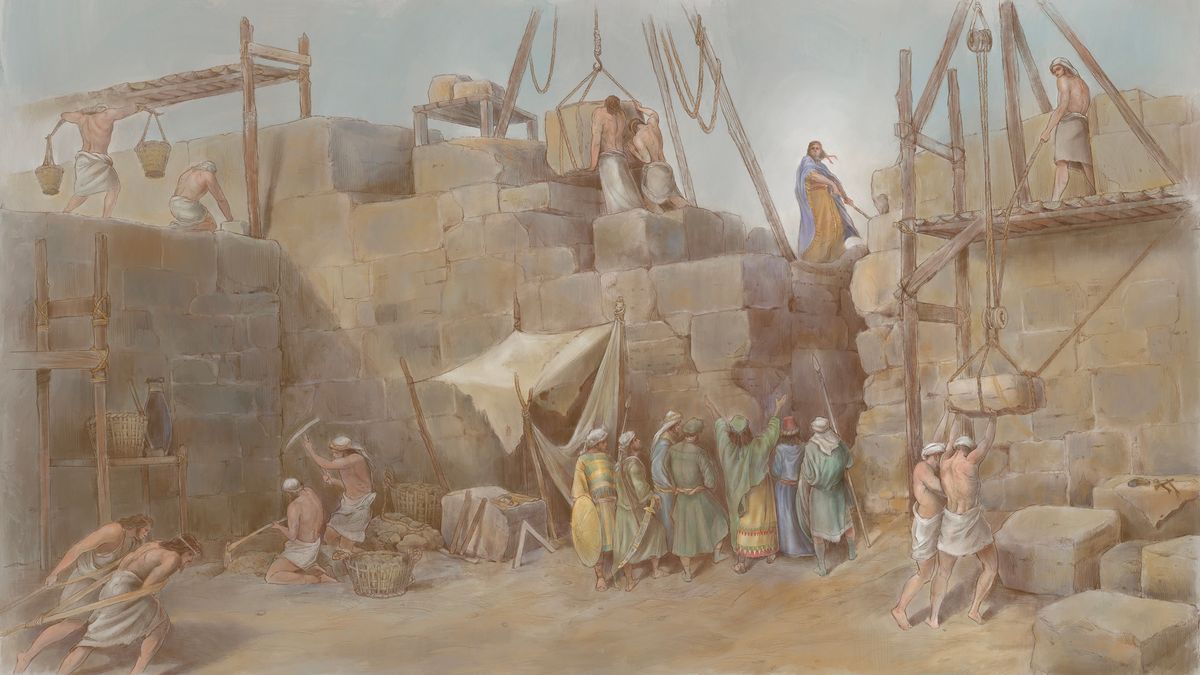
I Have a Great Work to Do · Tyson Snow
Last week · July 20–26
2 Chronicles 14–20; 26; 30
2 Chr 14–16Asa, king of Judah: trusting in God will bring me peace.
2 Chr 18Micaiah, one prophet against four hundred: I can defend the truth, even when it is unpopular.
2 Chr 20Jehoshaphat, Asa's son, surrounded by three armies: in difficult times, I can turn to God and His prophets.
2 Chr 26Uzziah, strong for fifty-two years: pride leads to destruction.
2 Chr 30Hezekiah hosting the rival northern kingdom at Passover: I can be a peacemaker.
This week · July 27–August 2
Ezra 1; 3–7; Nehemiah 2; 4–6; 8
Ezra 1The Lord inspires people to accomplish His purposes.
Ezra 3; 6The house of the Lord is a place of joy.
Ezra 4–7; Neh 2; 4; 6God has an important work for me to do.
Neh 8I am blessed when I study the scriptures.
Neh 5(in the reading, not in the lesson) Debt inside the walls.
Ezra 9–10; Neh 13(outside the block entirely) Where the reforms turn hard.
Setting · Where we are
Whose province is this? · Nehemiah 2:7; Ezra 4:10
THE EMPIREJudah is a district of Persia, the one the KJV calls "beyond the river." Cyrus, Darius, and Artaxerxes each rule it in turn. Every permission in these two books comes from a foreign throne.
NO KINGBabylon deported Jehoiachin in 597 BC, then took Zedekiah and burned the temple in 587. By Nehemiah's wall in 444 that is roughly 143 years with no king of their own, and they never get one back.
MEANWHILEAll of this happens inside the book of Jacob, about 544 to 421 BC. Mulek's colony fled the same fall of Jerusalem (Omni 1:15–16, footnoted at Ezra 2:1).
Setting · Who's who, and whose God is whose
The sides are messier than they look
THE PERSIANSCyrus, Darius, Artaxerxes. Not worshippers of Jehovah. They fund the temple, return its stolen vessels, and pay for the sacrifices out of tax revenue.
THE JEWSZerubbabel, grandson of the exiled king and the last of David's line in the Bible to lead in Jerusalem. Ezra, priest and scribe. Nehemiah, cupbearer to the king.
THE OPPOSITIONSanballat, governor of Samaria; Geshem, an Arabian; and Tobiah, called "the Ammonite," who is married into Jerusalem's own aristocracy (Neh 6:18) and gets a room in the temple from the high priest (13:4).
Part 1 · The Lord inspires people to accomplish His purposes
Read v. 1 and v. 2. Who stirred up Cyrus, and what does Cyrus himself claim in v. 2? Isaiah named him generations before he was born (Isaiah 44:28).
How do you see the Lord working through people around you, including people who are not members of His Church?
Part 1 · The Lord inspires people to accomplish His purposes
Read v. 2 aloud. What exactly do the neighbors say about who they worship? Now v. 3. Two outsiders offer help with the same temple; one gets a yes and one gets "ye have nothing to do with us." What difference does the text give you?
Where is the line between guarding what is sacred and refusing help God sent?
Part 2 · The house of the Lord is a place of joy
First read Psalm 137:1–4 for what they carried out of Babylon. Then vv. 12–13: two sounds at one dedication and nobody can tell them apart. Who shouts, who weeps, and why?
Why is the building of a temple a reason to celebrate, even when it is smaller than what was lost?
Part 2 · The house of the Lord is a place of joy
Twenty-one years after the weeping, the house is finished. Read vv. 16 and 22. What word keeps repeating, and who does v. 22 credit for it?
What have you seen finished that you were sure would not be?
Part 2 · The house of the Lord is a place of joy
Foundation about 536, finished 516. Only four of those years were building; sixteen were this one verse. Read Haggai 1:2 and 1:4 for what the builders were telling themselves. Is that opposition, or something else?
What work has God asked of you that is currently paused, and which kind of pause is it?
Part 2 · The house of the Lord is a place of joy
Two kinds of stopped work · the footnotes at Ezra 4:24 and 5:5
D&C 95:3, 8Kirtland, 1833, on a house they had been commanded to build and had not: "ye have sinned against me a very grievous sin, in that ye have not considered the great commandment … concerning the building of mine house." Haggai 1:4 in the Restoration.
D&C 124:49–51Read the whole condition before you claim it: those who "go with all their might and with all they have" and "cease not their diligence," and then are hindered. For them the Lord accepts the offering instead. He names Jackson County.
Which one is your stalled thing, honestly? Which half of v. 49 do you actually meet?
Part 2 · The house of the Lord is a place of joy
Read Haggai 2:9. What does God promise the men who wept? Their house had no ark, so its Holy of Holies stood empty. Five centuries later, as Herod rebuilt it, this is the temple Jesus taught in.
"Who hath despised the day of small things?" What are you calling a disappointment that God calls a foundation?
Part 3 · God has an important work for me to do
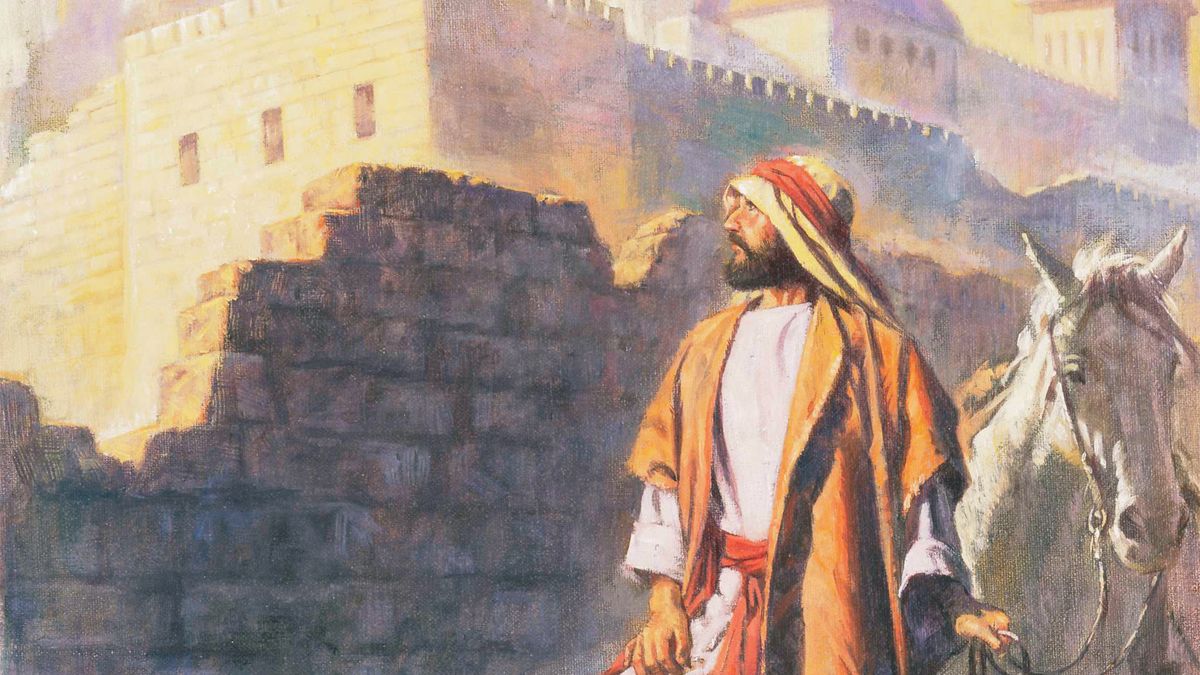
What he saw the night he rode out alone: Nehemiah 2:12–16
Nehemiah Inspects the Walls of Jerusalem · Robert T. Barrett
Part 3 · God has an important work for me to do
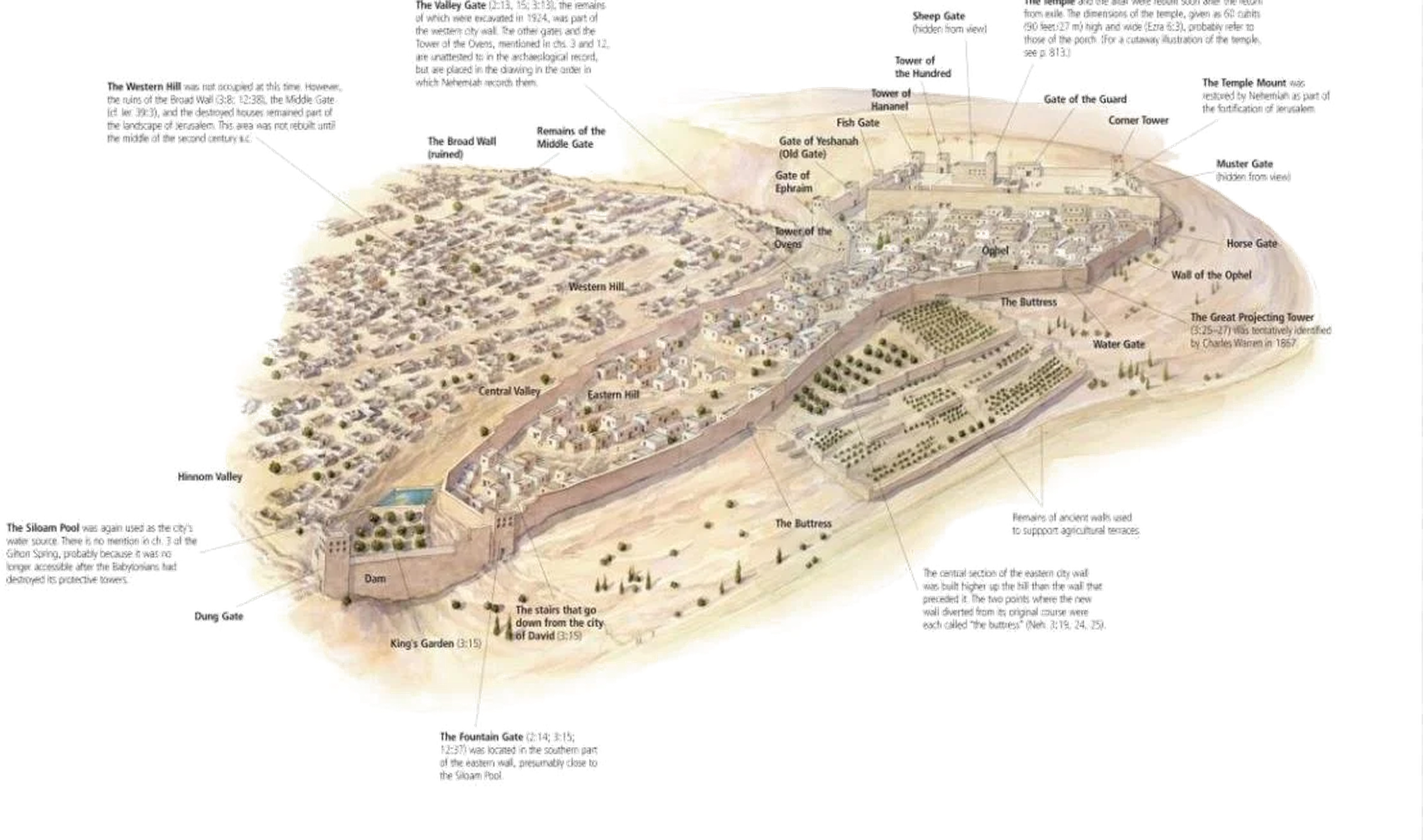
Jerusalem, about 444 BC · the gates of Nehemiah 3, and the water gate of Nehemiah 8
Part 3 · God has an important work for me to do
Both finishing lines, both dated to the day. The temple: about four building years inside twenty, restarted only when two prophets preached. The wall: fifty-two days, built by families each repairing the stretch in front of their own house.
Which of the things God has asked of you is temple work, and which is wall work?
Part 3 · God has an important work for me to do
Chislev in 1:1, Nisan in 2:1. Four months pass and he does nothing. Why is he "very sore afraid" in v. 2? Check whose stop-work order is still standing in Ezra 4:21. Then find the half-verse hiding between the king's question and his answer in v. 4.
What might it mean to have "the good hand of … God upon [you]" as you do His work? (v. 8)
Part 3 · God has an important work for me to do
Read vv. 12 and 16: three more days of silence, one animal, no announcement. In v. 14 the survey stops because "there was no place for the beast … to pass." Then v. 18: what does he tell them first, the king's letters or something else?
How have you seen His hand in your efforts to serve Him?
Part 3 · God has an important work for me to do
Verse 6: they "had a mind to work." By v. 10 they are saying "we are not able," and no blow has landed. What two things does Judah name in v. 10? Then vv. 13–14: what does Nehemiah do about that, and how is it different from the prayer and the watch in v. 9?
What do you think it means to have "a mind to work" in the service of the Savior?
Part 3 · God has an important work for me to do
"Think of the power we would have … if, in response to every temptation to lose focus or lower our standards, we responded, 'I am doing a great work and cannot come down.'"
President Dieter F. Uchtdorf · "We Are Doing a Great Work and Cannot Come Down," Apr 2009
What is the invitation to "come down" that you get most often, and what does it dress itself up as?
Next we back up one chapter. The worst threat to this wall was not outside it.
Part 3 · God has an important work for me to do
Read vv. 1–5. Who is doing this to whom? Not Sanballat. Verse 7 names the sin the law already forbids. Then v. 9 stacks a second argument on top of the law. What is it?
When the work looks good from the outside, what should we be checking on the inside?
Part 4 · I am blessed when I study the scriptures
Three generations without the law. Read vv. 2–3 and 5–6: who is there, how long does it go, and what do they do with their bodies? Then v. 8: what do the Levites add to the reading? Check the footnote on "gave the sense."
What in your life shows how you feel about God and His word?
Part 4 · I am blessed when I study the scriptures
They finally hear the law and it makes them cry. Read v. 10: what are they told to do instead, and who are they told to do it for?
When scripture cuts you, what is the prescribed next move?
Part 4 · I am blessed when I study the scriptures
The same reading produces this. Neh 13:1 begins "they read in the book of Moses," and v. 3 is a mass separation. In Ezra 10:2–3, who proposes putting away the foreign wives and their children? Look for a verse where the Lord commands it.
How do you tell the difference between what scripture commands and what you concluded from it?
Part 4 · I am blessed when I study the scriptures
Malachi preaches to this same community, about 430 BC. Read v. 11, then v. 16. Which one does he condemn: marrying outside the covenant, or putting away a wife? The Bible Dictionary entry on Malachi names both in one sentence.
How do you hold both halves of a hard truth without dropping one?
Closing
"Let us cheerfully do all things that lie in our power; and then may we stand still, with the utmost assurance, to see the salvation of God."
Name the one piece of wall in front of your own house this week.