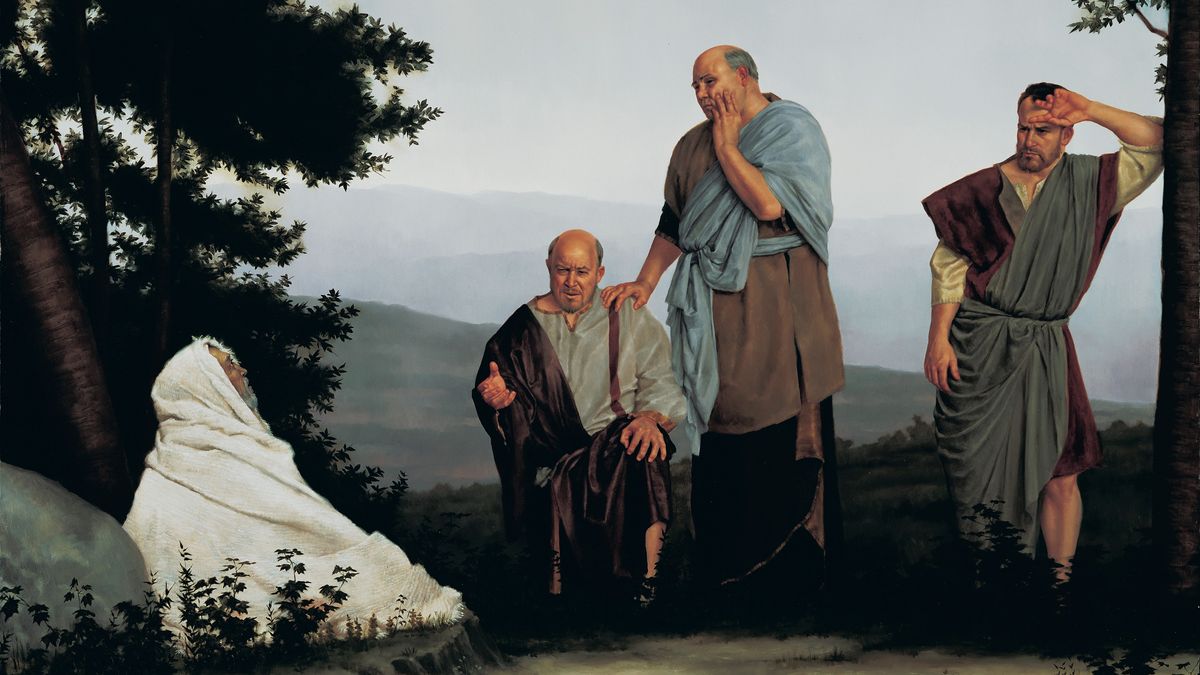
Job August 16, 2026

31 slides

In this lesson 31 slides
  1. 01"Yet Will I Trust in Him"
  2. 02Before we start
  3. 03Job 1–3; 12–14; 19; 21–24; 38–40; 42
  4. 04Setting · A different kind of book starts here
  5. 05Setting · A real man, told in verse
  6. 06Setting · Who is in the room
  7. 07Job 1:1–3, 6–12
  8. 08Job 1:20–22 · 2:9–10
  9. 09Part 1 · I can trust God in all circumstances
  10. 10The friends were right for seven days
  11. 11What Judaism built out of those seven days
  12. 12Job 3:1–3, 23–25
  13. 13Same house, same loss, not the same place
  14. 14Job 14:7–14
  15. 15Job 19:1–22, 23–27
  16. 16Four questions the seminary manual puts on the board
  17. 17Job 19:6–11, then Job 22:5–10
  18. 18Every line below sounds like faith
  19. 19Job 16:1–5
  20. 20Does God send it, or is it the fallen world? Both happen.
  21. 21James 5:11 · Job 23:3–4
  22. 22The one thing everybody remembers about him
  23. 23Part 3 · "When he hath tried me, I shall come forth as gold"
  24. 24Part 3 · "When he hath tried me, I shall come forth as gold"
  25. 25Job 9:32–33 · 16:19–21 · 23:3–7
  26. 26Job 38:1–7, 18–24
  27. 27Part 4 · God's perspective is greater than mine
  28. 28Job 42:1–8
  29. 29The daysman Job said did not exist
  30. 30Closing
  31. 31Closing · the mend
Job seated in ashes

Gospel Doctrine · August 16, 2026

"Yet Will I Trust in Him"

Job 1–3; 12–14; 19; 21–24; 38–40; 42

The Judgments of Job · Joseph Brickey

Before we start

Orthogonality is the mathematics of directions at right angles to one another. A lower-dimensional observer cannot track a coordinate perpendicular to their plane.

 
Projective geometry studies what happens to a figure when it is projected from one space into another. Just as a 3D perspective exposes every point of a 2D object, a higher dimension leaves every lower-dimensional interior completely visible.

A viewpoint above a plane, with sight lines reaching a point inside a closed shape drawn on that plane

This week · August 10–16

Job 1–3; 12–14; 19; 21–24; 38–40; 42

Job 1–3; 12–13I can trust God in all circumstances.

Job 19Jesus Christ is my Redeemer.

Job 21–24"When he hath tried me, I shall come forth as gold."

Job 38–40; 42God's perspective is greater than mine.

Setting · A different kind of book starts here

FROM HERE ONJob, Psalms, Proverbs, Ecclesiastes, and the Song of Solomon are the books of poetry, or wisdom literature. That is the next four weeks of our reading.

WHY IT MATTERSPoetry is a device, not a lesser kind of truth. It compresses, it stages, it says a thing twice in two ways. We read it for what it is doing, not only for what it reports.

SO, CAREFULLYKeep each line in its context and ask who is speaking. About a fifth of the book is spoken by men God corrects in 42:7. Before we take comfort from a line in Job, it is worth asking who said it.

Setting · A real man, told in verse

IT HAPPENED"Job was a real person" (seminary manual, lesson 97). The Lord tells Joseph Smith in Liberty Jail "thou art not yet as Job," and speaks of Job's friends contending with him as a real event (D&C 121:10). See also James 5:11; Ezekiel 14:14, 20.

CHAPTER 1The council scenes show Satan's real role as accuser "in a poetic way; they don't describe an actual interaction between God and Satan" (Come, Follow Me). The staging is poetic. The accuser is not.

SOThe one place the book looks like it explains itself is the place the manual reads as poetry. Job never learns why this happened to him, and the book never tells us either.

Setting · Who is in the room

JOBA wealthy man of Uz, outside Israel. Ten children, seven thousand sheep, "perfect and upright" (1:1).

HIS WIFEShe buried the same ten children, and she speaks one time in the whole book: 2:9. Job mentions her twice more and she is still there (19:17). Everything else we think we know about her, we added.

THREE FRIENDSEliphaz, Bildad, and Zophar, who travel in from three different countries to mourn with him (2:11–13) and stay to argue with him through chapter 25.

Part 1 · I can trust God in all circumstances

Job 1:1–3, 6–12

Read v. 1. Seminary lesson 97 glosses "perfect" as "whole, complete, having integrity," not free from error. Now vv. 9–11: what claim does the accuser make about why Job is righteous?

"Why do I remain faithful to God?" Why would it be dangerous to obey the Lord solely for the reason Satan suggested?

Part 1 · I can trust God in all circumstances

Job 1:20–22 · 2:9–10

What impresses you about Job's responses to his trials? What might Job have understood about God to respond the way he did?

His wife lost the same ten children and says "curse God, and die." What does the text actually tell us about her, and what do we add?

Part 1 · I can trust God in all circumstances

"… and smote Job with sore boils from the sole of his foot unto his crown. And he took him a potsherd to scrape himself withal; and he sat down among the ashes."

Job 2:7–8

A potsherd is a broken piece of pottery. He is scraping himself with garbage, sitting in the ash heap outside of town. Every word after this comes out of a man in that condition.

Broken pottery on the ground Detail · Job Afflicted
with Disease

Part 1 · I can trust God in all circumstances

The friends were right for seven days

Job 2:11–13 · Mosiah 18:8–10

Three countries, seven days on the ground, not one word, "for they saw that his grief was very great." It all goes wrong the moment they speak. What changed?

When have you been blessed by someone's effort to comfort or mourn with you?

Part 1 · I can trust God in all circumstances

What Judaism built out of those seven days

SHIVAHebrew for seven. After a burial, mourners sit low in the house for seven days while the community comes to them. The seven-day count is anchored in Genesis 50:10, Joseph mourning his father.

THE RULEA visitor does not speak first. You wait until the mourner speaks. The classic text behind that custom is Job 2:13, these three men on the ground saying nothing for seven days.

SOAn entire practice of grief was built on the one thing Job's friends got right, and the wheels come off the moment they break the rule.

Jewish practice, not Gospel Library doctrine. Offered as what another people who keep this book do with it.

Part 1 · I can trust God in all circumstances

Job 3:1–3, 23–25

Read v. 3 aloud, then vv. 23–25. How would you describe Job's feelings here? What might be the difference between feeling grief and feeling hopeless?

How can we invite Heavenly Father and Jesus Christ to help us work through such feelings?

Part 1 · I can trust God in all circumstances

Same house, same loss, not the same place

Job 2:9–10 · 19:17

She speaks one time in the whole book, and he answers without answering back. Read v. 10 slowly. What does Job call foolish, and what does he not call foolish? By 19:17 they are still in the same house.

How do we deal with some in hour homes that don't agree with our faith, that argue against it?

Part 2 · Jesus Christ is my Redeemer

Job 14:7–14

Mark the two questions Job asks here. Verse 10 is "where do we go when we die"; verse 14 is the other one. What answer does he have at this point in the book?

What questions might you have had if you were Job? When have you heard or asked similar ones?

Part 2 · Jesus Christ is my Redeemer

Job 19:1–22, 23–27

Read vv. 23–24 first. What does Job want done with these words? Then vv. 25–27. A redeemer in the Old Testament was "someone, usually a relative, who was responsible for restoring a person's possessions, status in society, or personal freedom" (Scripture Helps). That is Boaz in Ruth 4. What is Job claiming he has?

How do you know that your Redeemer lives? What difference does this knowledge make in your life?

Part 3 · "When he hath tried me, I shall come forth as gold"

Four questions the seminary manual puts on the board

1"I must be doing everything wrong. Why else is life so hard for me?"

2"If I'm following the gospel, why am I not able to avoid trials and suffering?"

3"I thought God loved me. Why is He making my life so difficult?"

4"If God is real, why doesn't He stop people's suffering?"

What are some assumptions people might be making when they ask questions such as these?

Part 3 · "When he hath tried me, I shall come forth as gold"

Job 19:6–11, then Job 22:5–10

First, what does Job assume about God in 19:6–11? Then read what Eliphaz assumes about Job in 22:5–10, and notice he invents specific sins. What inaccurate assumption is each man making?

Job's friends suggested that God was punishing him. What problems do you see with this idea?

Part 3 · "When he hath tried me, I shall come forth as gold"

Every line below sounds like faith

What the friends said

How it comes out today

Bildad, to a father who buried ten children days earlier: "If thy children have sinned against him, and he have cast them away for their transgression" (8:4)

"God doesn't take someone without a reason. I bet they wished they had kept coming to church..."

Zophar: "God exacteth of thee less than thine iniquity deserveth" (11:6)

"Honestly, it could be a lot worse. Count your blessings."

Eliphaz: "Is not thy wickedness great? and thine iniquities infinite?" then invents the sins (22:5–9)

"There has to be something you're not telling us. Have you been reading your scriptures?"

Eliphaz, opening the whole argument: "who ever perished, being innocent? or where were the righteous cut off?" (4:7)

"God is teaching you something here. Try to be grateful for the lesson."

God, about all three: "ye have not spoken of me the thing that is right" (42:7)

"It is unworthy of us as Christians to think that those who suffer deserve their suffering." Dieter F. Uchtdorf, then of the First Presidency, "You Are My Hands," May 2010

Part 3 · "When he hath tried me, I shall come forth as gold"

Job 16:1–5

Job answers all of it in five verses. What does he call them in v. 2, and what does he say in v. 4 that he could do if the seats were switched? Then v. 5: what would he do instead?

Which of those four have you said, meaning well? What would "mourn with those that mourn" have sounded like in that moment?

Part 3 · "When he hath tried me, I shall come forth as gold"

Does God send it, or is it the fallen world? Both happen.

He sends it

Thorns and thistles

The plagues on Egypt: "I will multiply my signs and my wonders" (Ex 7:3; 12:12)

The tower of Siloam fell on eighteen: "think ye that they were sinners above all men? I tell you, Nay" (Luke 13:4–5)

Israel in the wilderness, "to prove thee, to know what was in thine heart" (Deut 8:2)

The man born blind: "neither hath this man sinned, nor his parents" (John 9:1–3)

"I give unto men weakness that they may be humble" (Ether 12:27)

"Of few days, and full of trouble" (Job 14:1); the ground is cursed (Moses 4:23–24)

Either way: turn to God, and let the nature change. Mosiah 24:13–15 · Mosiah 3:19 · D&C 122:7

Part 3 · "When he hath tried me, I shall come forth as gold"

James 5:11 · Job 23:3–4

"Ye have heard of the patience of Job." Read the rest of James 5:11: what word does James actually use for it? Now read 23:3–4, where Job wants a courtroom and a mouth full of arguments. Is that patience?

If endurance can look like arguing, do we share our true feelings with the Lord, are we willing to hear the answers?

Part 3 · "When he hath tried me, I shall come forth as gold"

The one thing everybody remembers about him

AYYUBIslam keeps Job as a prophet. The account is short: he prays, God heals him with a spring at his feet, and his family is restored (Qur'an 38:41–44; 21:83–84).

SABRHe is the model of patient endurance, and his prayer is taught as how to ask in affliction: name your condition, name God's mercy, demand nothing.

WHAT IS MISSINGNo council scene, no three friends, no thirty chapters of argument, no whirlwind. What is unique to our text is the part we skip, and it ends with God saying Job spoke rightly (42:7).

Background, not Gospel Library. Three faiths kept this man; only ours kept the argument.

Part 3 · "When he hath tried me, I shall come forth as gold"

"Answer, if you can. I cannot, for though I know God has a major role in our lives, I do not know how much he causes to happen and how much he merely permits."

"Sometime we'll understand fully, and when we see back from the vantage point of the future, we shall be satisfied with many of the happenings of this life that are so difficult for us to comprehend."

"Tragedy or Destiny?", Teachings: Spencer W. Kimball

He lost his mother at eleven and still wanted to sob fifty years later. Not knowing why did not stop him. What does that make possible for you?

President Spencer W. Kimball President
Spencer W. Kimball

Part 3 · "When he hath tried me, I shall come forth as gold"

"To ask, Why does this have to happen to me? Why do I have to suffer this, now? What have I done to cause this? will lead you into blind alleys. … Rather ask, What am I to do? What am I to learn from this experience? What am I to change? Whom am I to help?"

"Trust in the Lord," Oct 1995

Now read Job 23:3–10. Which of Elder Scott's two lists is Job on in vv. 3–4? Where is he by v. 10?
Elder Richard G. Scott Elder
Richard G. Scott

Part 3 · "When he hath tried me, I shall come forth as gold"

Job 9:32–33 · 16:19–21 · 23:3–7

Job is not asking for comfort, he is asking for a hearing. Read 9:32–33: what does he say does not exist between him and God? Then 23:6–7: what does he think would happen if he ever got into that courtroom?

What would you file, if you could?

Part 4 · God's perspective is greater than mine

Job 38:1–7, 18–24

God finally speaks, and across chapters 38 to 42 He asks "at least 66 questions" (Elder Renlund) and answers none. What do you learn from the questions in vv. 4–7? How would you summarize that message?

Verse 7 puts us all there, shouting for joy. When we face challenges, why might it help to remember that we rejoiced at the chance to come here?

Part 4 · God's perspective is greater than mine

"It was as if God had patiently and kindly said to Job, 'If you cannot answer even one of my questions about the earth that I have created, is it possible that eternal laws exist that you do not understand? Are there assumptions you have made that are invalid?' … God in His wisdom knows that a vital part of our mortal experience is to not know everything."

Elder Dale G. Renlund · "Trust God and Let Him Prevail," Liahona, Aug 2022

What does this statement help you understand about God and trials?

Elder Dale G. Renlund Elder
Dale G. Renlund

Part 4 · God's perspective is greater than mine

Job 42:1–8

Read v. 5. What changed for Job, since it was not information? Now v. 7: who does God say spoke of Him rightly, and who does He say got Him wrong?

The friends defended God the whole book and He rejects their defense. What were they doing that we do?

v. 6, "I abhor myself": the word myself is italicized, meaning it is not in the Hebrew, and the verb can mean recant. Scripture Helps offers "Therefore do I recant, and I repent in dust and ashes." Renlund: Job "repented of attributing his suffering to sin."

Part 4 · God's perspective is greater than mine

The daysman Job said did not exist

Job 9:33"Neither is there any daysman betwixt us, that might lay his hand upon us both." An umpire who can touch both parties at once. Job says there is none.

D&C 45:3–5"Listen to him who is the advocate with the Father, who is pleading your cause before him, saying: Father, behold the sufferings and death of him who did no sin … spare these my brethren that believe on my name."

PACKER"Unless there is a mediator, unless we have a friend, the full weight of justice untempered, unsympathetic, must, positively must fall on us." (Elder Boyd K. Packer, "The Mediator," Apr 1977)

Job asked for a courtroom and got a whirlwind. The Mediator he says does not exist is the One he names in 19:25.

Closing

Job 42:10–15 · D&C 122:7–8

The turn comes in v. 10, "when he prayed for his friends." He gets double the sheep and double the camels. Count the children in v. 13. Why not double?

"All these things shall give thee experience, and shall be for thy good. The Son of Man hath descended below them all."

Closing · the mend

Kintsugi. "golden joinery" the Japanese craft of repairing a broken bowl with gold, so the mend is the most visible thing on it.


Just as Job, our Redeemer mends what we cannot mend, and who kept His own scars to prove He had been where we are.

"Jesus Christ loves to restore what we cannot restore,
heal wounds we cannot heal, fix what is irreparably broken,
and compensate for any unfairness we have endured."
Elder Dale G. Renlund,
"Trust God and Let Him Prevail," Liahona, Aug 2022, 7

A bowl broken and repaired with gold seams

Lesson revision 0948a0bd07ea